AI Change Control
for Engineering Teams
SignalBrain Forge turns AI-initiated engineering changes into auditable, policy-controlled pull requests with tests, blast-radius analysis, signed receipts, and rollback evidence.
Let agents do the work. Keep humans in control.
AI coding tools can write code. They cannot prove the change was safe.
Engineering leaders are being asked who authorized an AI-initiated change, what policy gates ran, what files changed, what tests passed, what evidence supports the decision, whether it failed closed, and whether rollback is ready.
When evidence is missing or a tool would fake success, Forge records BLOCKED — not a green checkmark with nothing behind it.
SignalBrain Forge gives you that answer.
Runtime-hardening tickets become auditable, mergeable PRs.
Settled packages are not a shipped product until they compose.
Multi-module Forge work merges settled package branches into an integration branch in build order, then runs assembly-level smoke from runner-attested evidence. A request is not complete until assembly is verified — or a remediation package is opened when compose or smoke fails.
composePackageBranches; conflicts block assembly with recorded paths.verified.Assembly states recorded from evidence only: pending → ready_to_compose → composed → verified | smoke_failed | blocked. Receipts can include integration branch, integration commit, package commits, and smoke stdout/stderr hashes.
Forge reached a settled verdict on real repo work.
A bounded runtime-hardening attempt moved through the full Forge lifecycle: submitted, verified, and settled. The run produced branch and commit evidence, an API-side receipt, and R1/R2/R3 runtime-hardening checks before Forge marked the package verified.
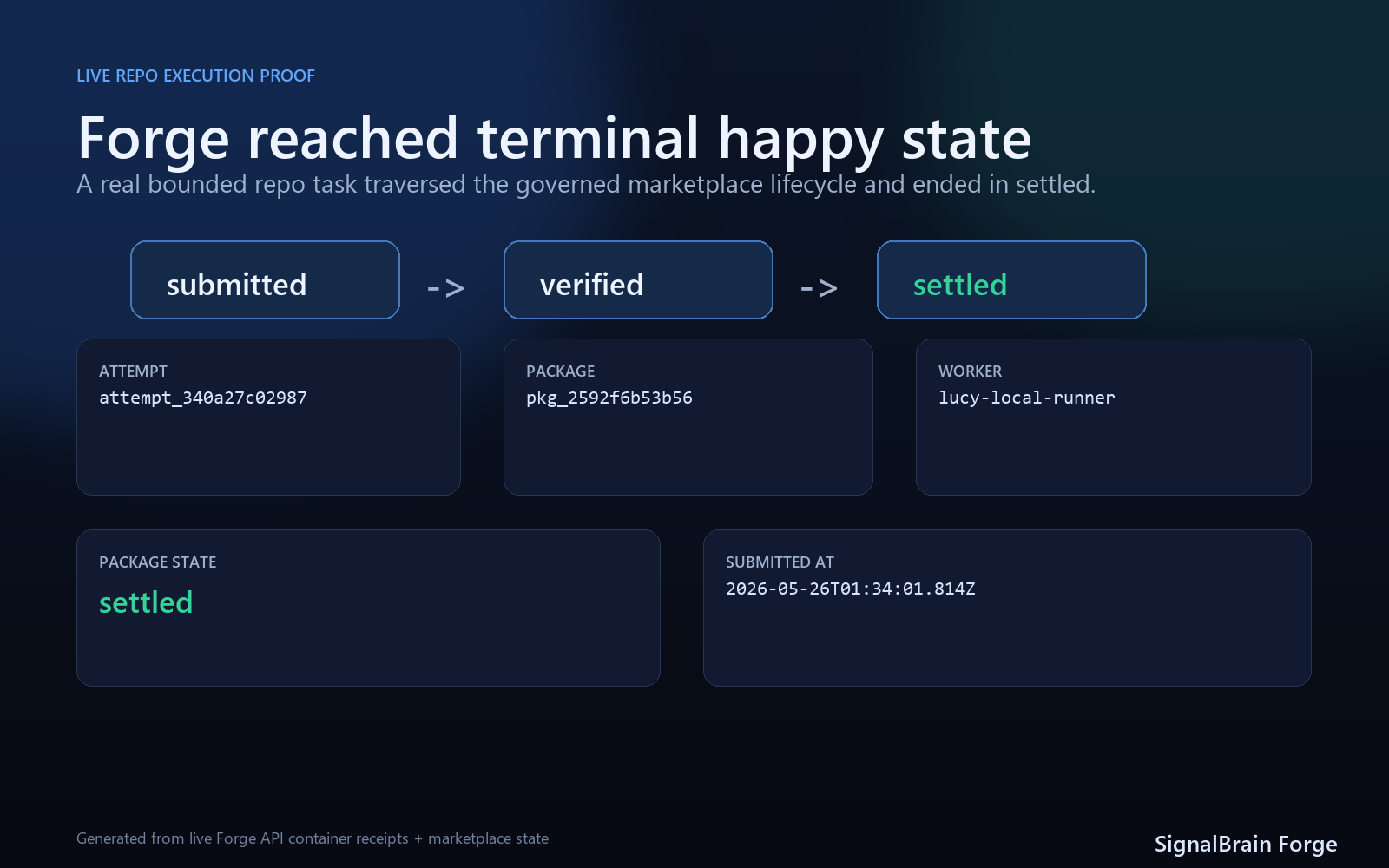
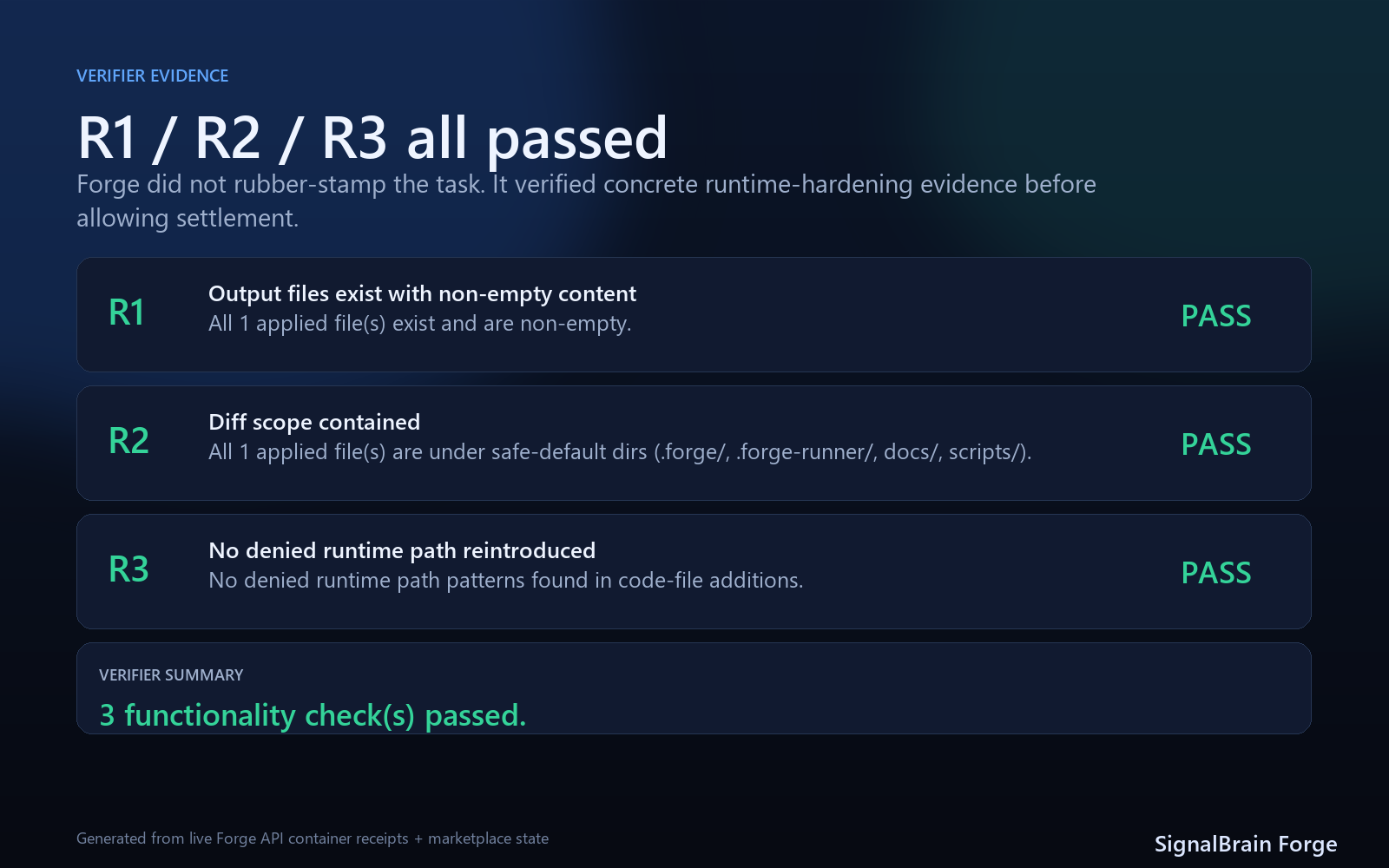
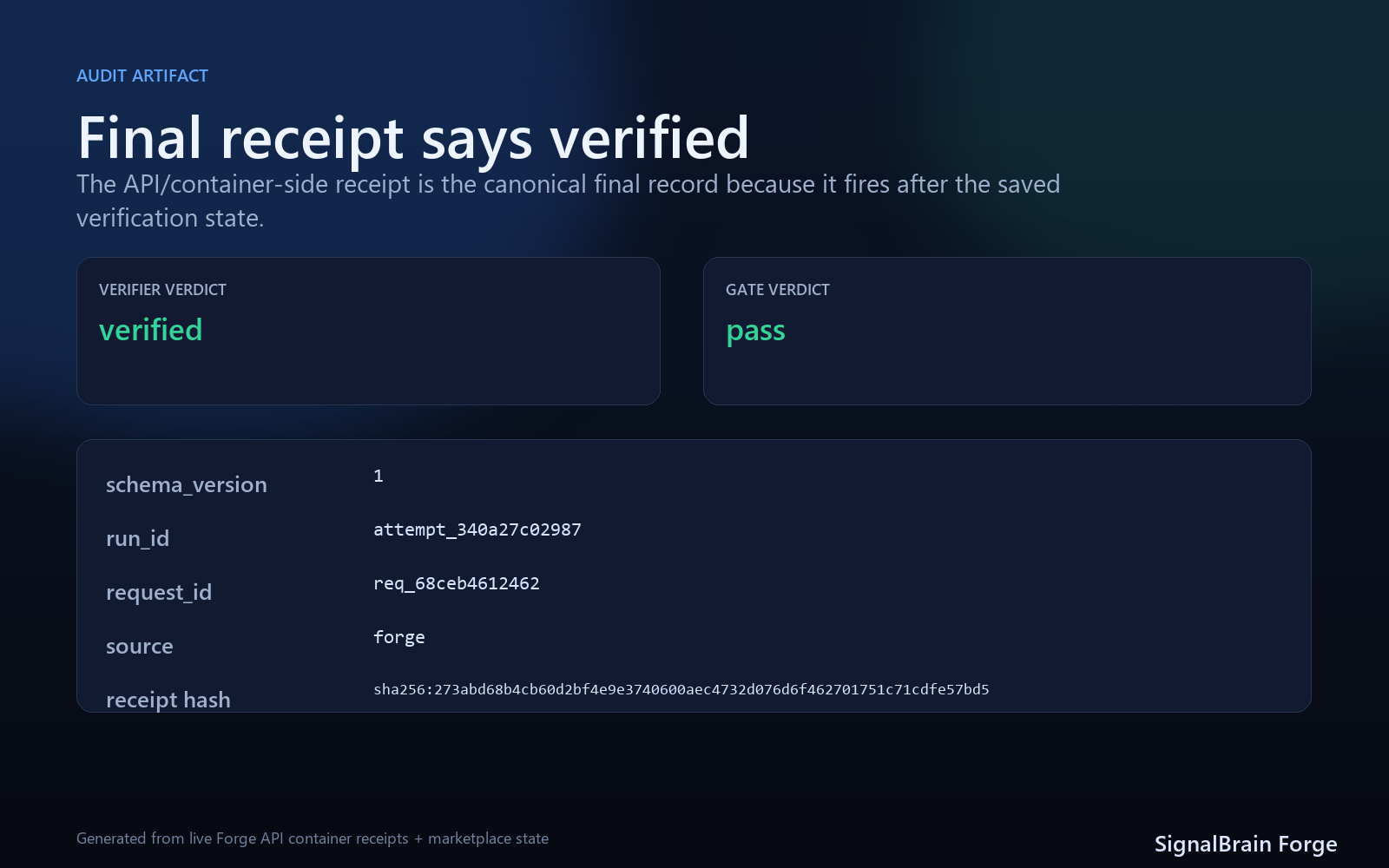
Screenshots are redacted public proof generated from a local settled Forge run. Raw marketplace records, internal paths, and private repository data remain outside the public website.
The agent is the demo. The receipt survives audit.
Every governed change produces a signed receipt that records what was requested, who or what proposed it, which gates judged it, what changed, and how it can be rolled back.
Runtime Hardening PRs
Forge is purpose-built for high-trust engineering work: removing unsafe runtime dependencies, fixing production config drift, adding missing contract tests, validating container/runtime parity, enforcing governance invariants, and producing readiness evidence before deployment.
For platform teams
AI-assisted work without uncontrolled mutation, backed by deterministic checks and reviewable evidence.
For SRE
Policy gates that fail closed, readiness proof, blast-radius reports, and rollback notes before production change.
For security
PR-level audit evidence, provenance, signatures, and contract-test discipline around every governed change.
Runtime Hardening Pilot
In 30 days, SignalBrain Forge helps identify and execute 3-5 runtime-hardening changes in your repository. Each change includes a scoped ticket, governed PR, blast-radius analysis, contract tests, verification evidence, signed receipt, rollback notes, and final readiness report.
Pilot accounting: verified-work states are simulated — receipts and lifecycle evidence, not payment movement. Human merge to main always.
AI-initiated engineering changes, controlled by policy, proven by receipts.